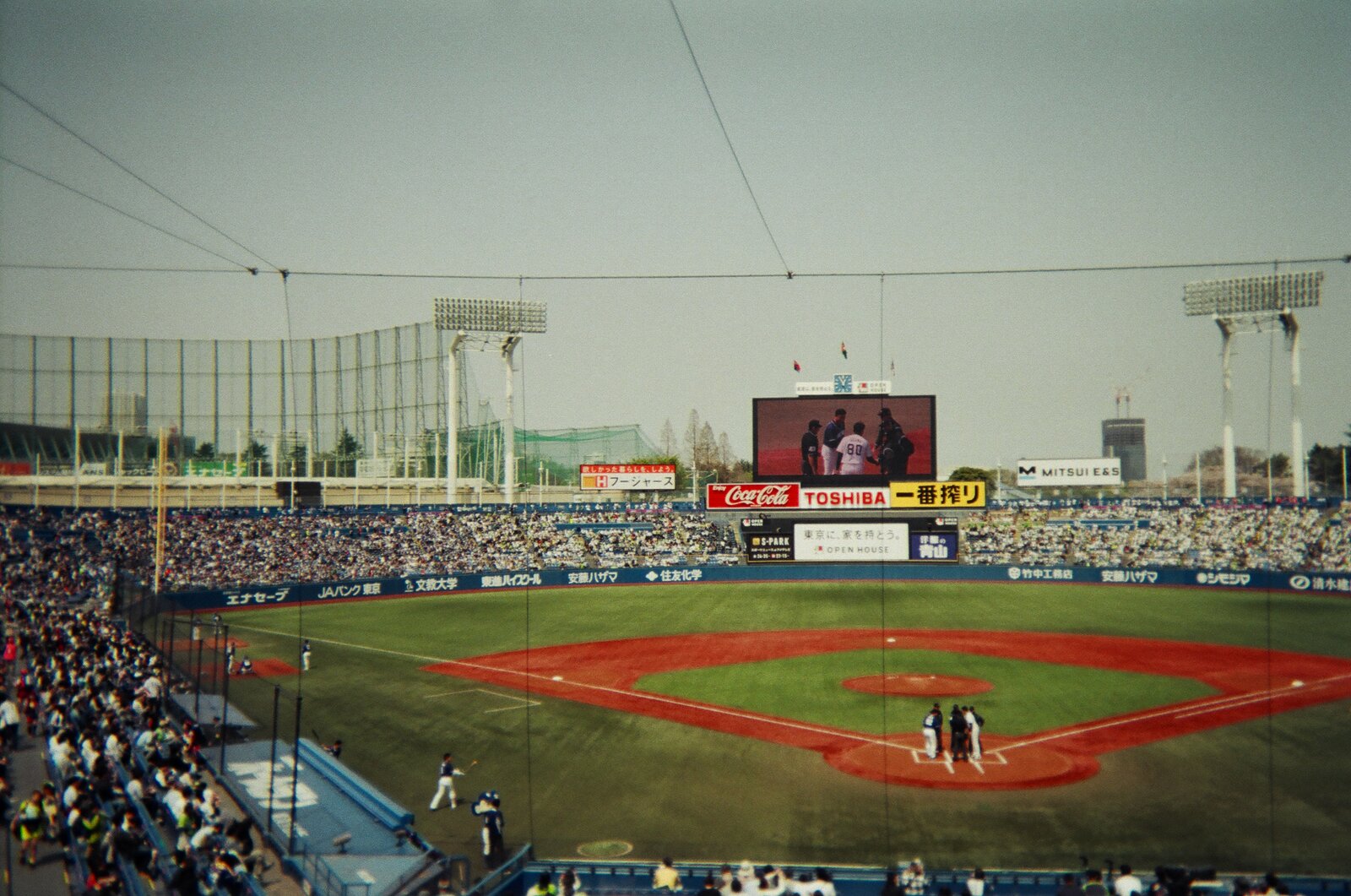
 Developing my disposable camera film gave me this gem of a memory of Meiji Jingu Stadium.
Since I wrote my last blog, I’ve done a little soul-searching. 14 months ago, I started a job in an unfamiliar industry. I pondered going back to higher education, albeit briefly. I was unsure whether I wanted to continue pursuing a job in baseball after striking out on three different job opportunities. In short, I was one big freak-out from the rite of passage afforded to all 25-year-olds known as the quarter-life crisis.
Like its older yet more ballyhooed cousin, the midlife crisis, my soul expedition was borne out of the desire to define myself within the context of my life. I was trying to answer every question about my existence, all at once. I failed to realize that’s how you accidentally overstep the razor thin margin between being in control of your life and considering crisis coping mechanisms. It took me a while to figure out how to observe myself on the line without toeing or crossing that threshold. I reverted to old tactics and incorporate new coping strategies into my life.
I read more - a practice I failed to keep up from my childhood. I traveled to places I was unfamiliar with and revisited places I knew intimately. I tried to broaden my self-induced narrowing horizons in an attempt to make sense of how others live. From those experiences, I tried to live in the moment and unpack more of what matters to me.
I love independent booksellers (Hey Powell’s), but Amazon is king when it comes to getting 100 recommendations spiraling down upon you in an hour. One internet rabbit-hole later, I ordered and read a book on Ikigai, the Japanese concept meaning “a reason for being”. I learned from this concept that genuine satisfaction, feelings of success, and personal contentment comes from within, not from external sources. This book spurred me to read more as I realized that my thirst for knowledge and answers was quenched with information, opinions, and different vantage points on all of life’s little nuances.
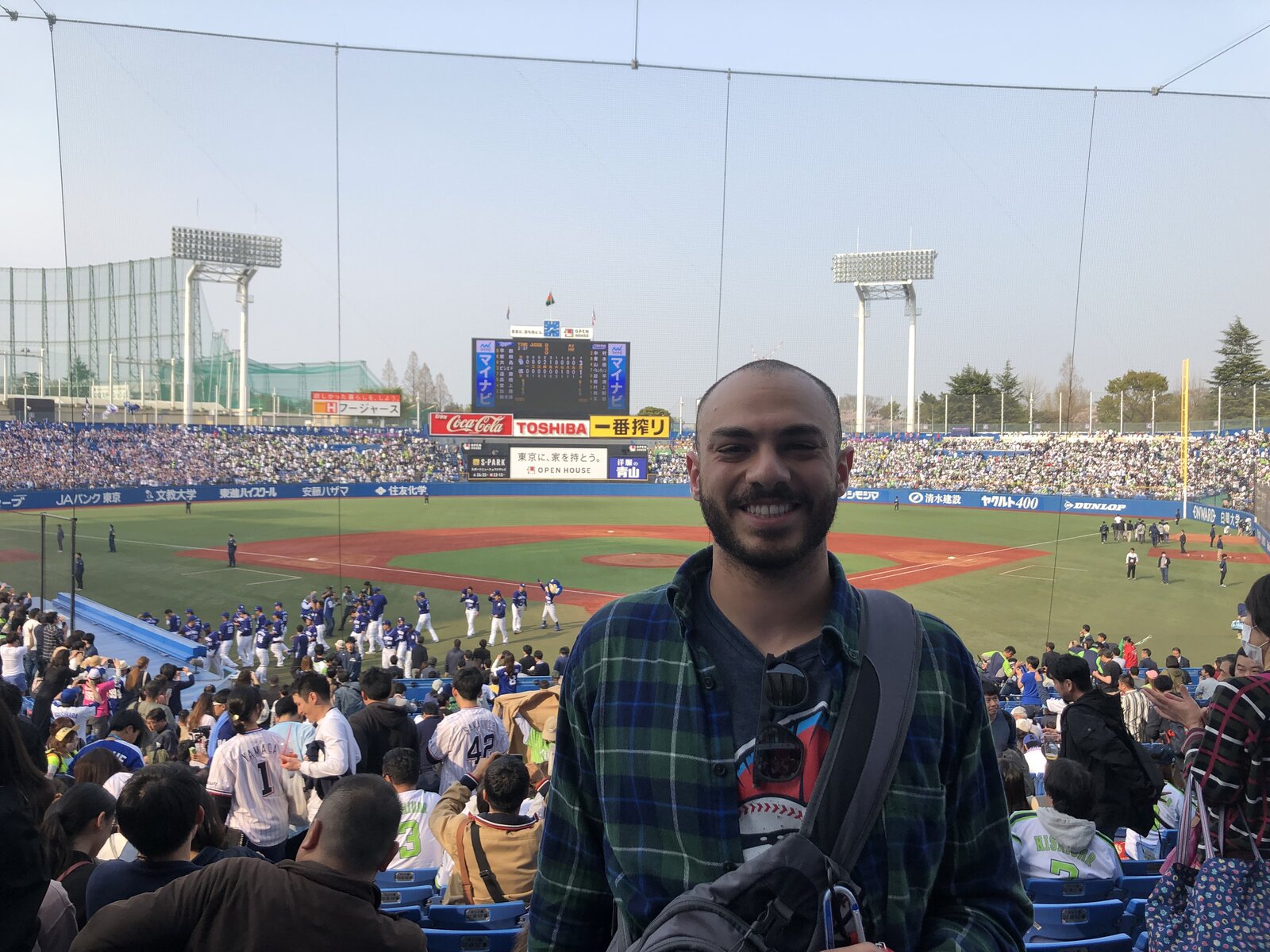 Me being very cheesy and very touristy.
After I read Ken Mogi’s book, I embarked on a mini-Japan kick. I was intrigued by the culture, the mindset, and the physical isolation of the island - I wanted to explore how this impacted the quotidian way of life. after some maneuvering and stashing of vacation days along with a well-timed promotion, I was fortunate enough to travel to Japan eight months later and attend a Yakult Swallows game.
I could tell you I kept score. I could tell you that I remember everything about the game in picture-perfect detail. As fun as it would be to describe Japanese pitch selection theory, or hit and run strategy, I can’t do that in good faith and fudge analysis on why I think the NPB is more or less pure than its older, more famous brother. I can in good faith tell you that I loved the experience. That early April afternoon on a partly cloudy day is so firmly planted within within my mental travel log to the point that I remember who I sat next to and what we talked about more than the game. I remember the walk to the game from the train in more detail than I do the final score. I recognized Wladimir Balentien playing third, and that paled in comparison to meeting someone else at the game from Portland.
The game was memorably normal - the type of game you’ve watched in the background of a lazy Saturday afternoon hundreds of times. The Swallows played the Chunichi Dragons, two teams that do not evoke the same global response as the Yomiuri Giants or the Hanshin Tigers, but novel and wondrous just the same. I went to Meiji Jingu Stadium for the history of the stadium (Babe Ruth played there on a 22-game tour of Japan in 1934), and because it conveniently fit my schedule. It was either checking out the Swallows in Tokyo, or trying to hustle to Hiroshima in a couple days to catch the Carp on the last day of their homestand.
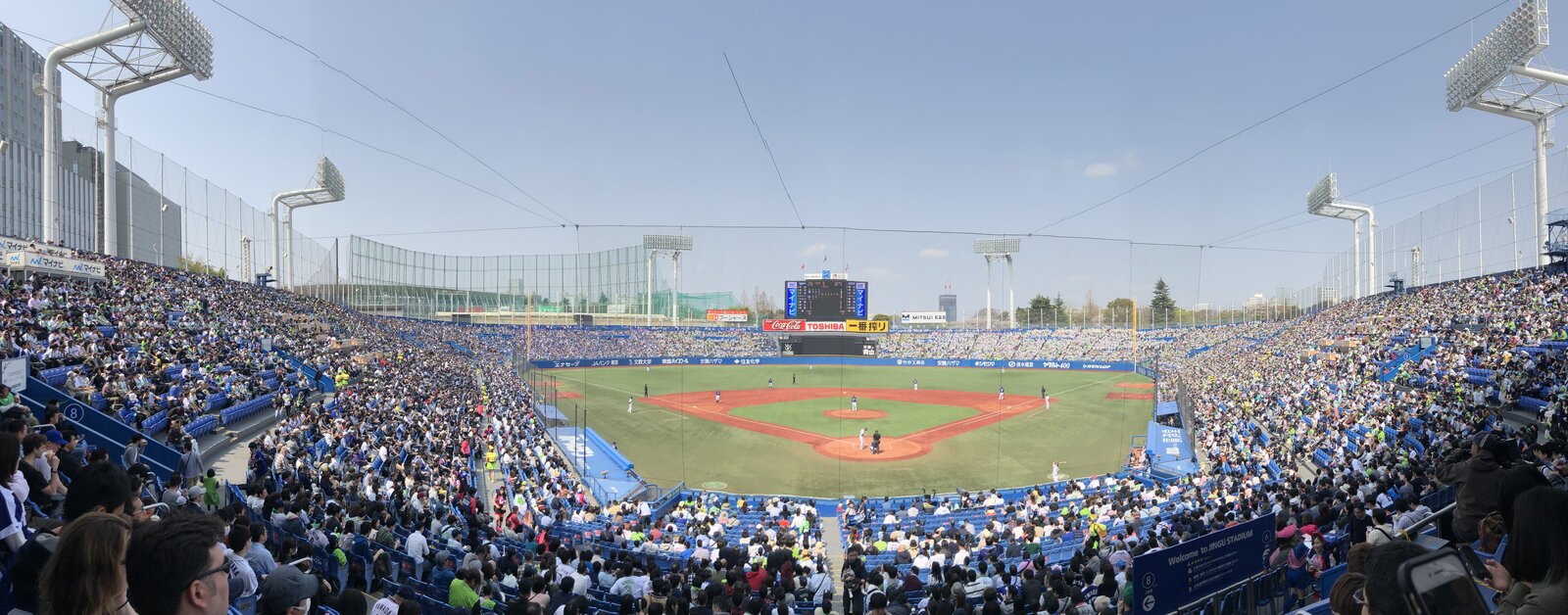 This stadium is older than both the Iron Lung and the concept of antibiotics. No word on if this stadium has saved lives though.
There are a few Japanese customs at baseball games that just simply don’t exist when watching baseball at an MLB stadium. You do not boo - in fact, Japanese baseball is entirely wholesome. The chants and cheers are coordinated and executed in happy, military-like precision. You can bring in your own food and beer akin to your own personal potluck. So different, yet we haven’t even broached the differences in the game being played on the diamond. It’s like watching a foreign movie with subtitles - you get the gist of what’s going on, but the essence is lost in translation.
I sat next to a Japanese father and his child 20 minutes before the first pitch. Although I was ignorant enough to only pick up the basics of Japanese before I traveled (read: the basic traveler’s folio of Hello/Goodbye plus the usual convenience-related inquiries such as food/drink/bathroom/train station), I was able to speak the language of baseball with them and talk about their favorite teams and players. Our conversation evoked that wonderful feeling ever-present in baseball more than any other sport: nostalgia. I showed them a video of Shohei Ohtani I’d captured the previous May in Seattle, and the boy of 8 or 9 shyly translated the baseball cards I’d received with a packet of chips (with the aid of some poorly-mimed actions for errors and stolen bases).
I think about this conversation and afternoon a lot and how it’s affected me in the grand scheme of the past year and a half.
As I set out to write this, I realized I was returning from an informal blog-hiatus spanning over a year. I had to come to some fundamental conclusions about myself. I asked, “what is the point of writing and keeping this blog up?” Was it to settle back into what I wanted - to analyze baseball for a living? Was it to explain why I didn’t want to do this for the sake of doing it, and absolve me of the guilt I feel about abandoning a project I’m passionate about? Did I just want to humble-brag about my trip to Japan?
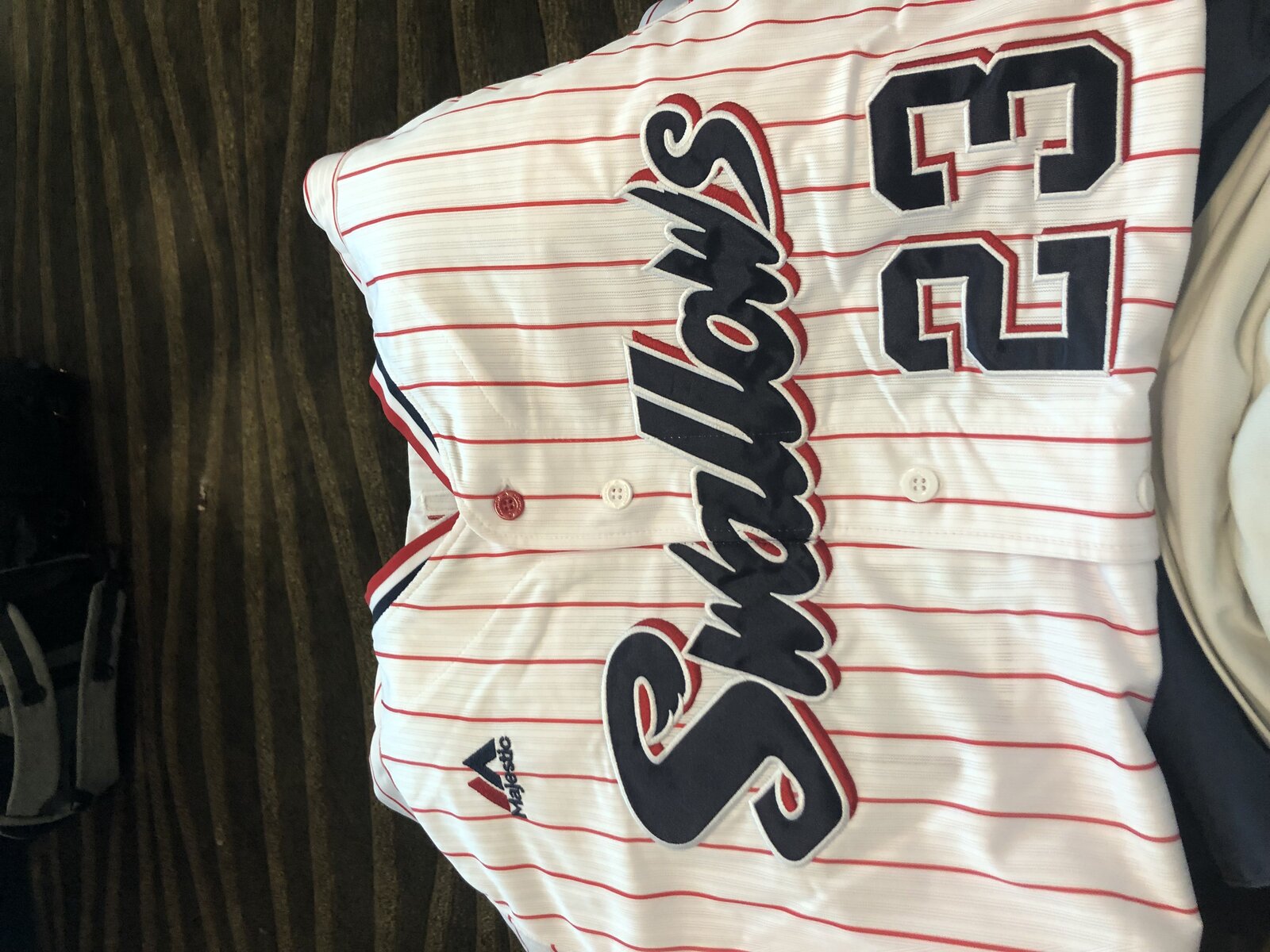 My humble-brag: A sweet Yakult Swallows Aoki/MJ Jersey.
Well I found that the answer to these questions is much like the game of baseball worldwide. The framework is the same, but success is fundamentally dependent on your environment. A player that hits 10 home runs and strikes out 50 times in a season is seen as a lot more valuable in NPB as compared to MLB - does that make him worse in the USA? Does the talent evaporate over the Pacific Ocean? The answer is dependent on the lens and environment you are surveying the question through. (This also isn’t a nuanced study of international quality of play.)
The game between the Dragons and the Swallows was fundamentally different for myself and the duo sitting next to me - I was the walking, talking American embodiment of “happy to be here”. Sitting in the shade of Meiji Jingu Stadium’s press box, our differing lens coalesced into something more than just enjoying a ballgame. It allowed us to share something more human. We shared a small slice of our life - three hours as the most kindred of spirits.
I needed a break from thinking about baseball as a profession, so I took one. I took a break from this blog and essentially sat out the second half of the 2018 season. I stopped trying to view baseball as a potential career, and became a fan again. I learned to take a different approach to digesting, consuming, and contextualizing baseball.
Unsurprisingly (or not), this introspection coincided with significant life events outside of baseball, and it has taught me to practice patience. Baseball is a sport without a timeline, without strict deadlines to hit, and I needed to approach my life the same way. You have to play 9 innings in order to completion - whether it’s a Beuhrle 1h50m masterpiece or a Red Sox-Yankees Sunday Night slugfest makes no difference. Predicting the future is as much a fool’s errand as trying to institute a pitch clock - it changes the rules and pretty soon you realize you’re not even playing the same game anymore.
Bear with me for a second and indulge this thought exercise of mine. Every so often in a big crowd (read: more often than I’d like to admit), I’ll imagine everyone in the crowd has a “life string”, a path upon which their life is plotted to date. When a big crowd gets together, such as 40,000 people at a baseball game, I imagine 40,000 life strings converging on the same point in time, only to scatter to the four corners of the world once the game ends like a scaled down neural network. More likely than not, that will be the only time that that unique collection of 40,000 life strings converge. Why waste time trying to predict the future when you can enjoy each of these delicious life string convergences in the moment? Why fret about the future when being mindful about the present is so much more rewarding?
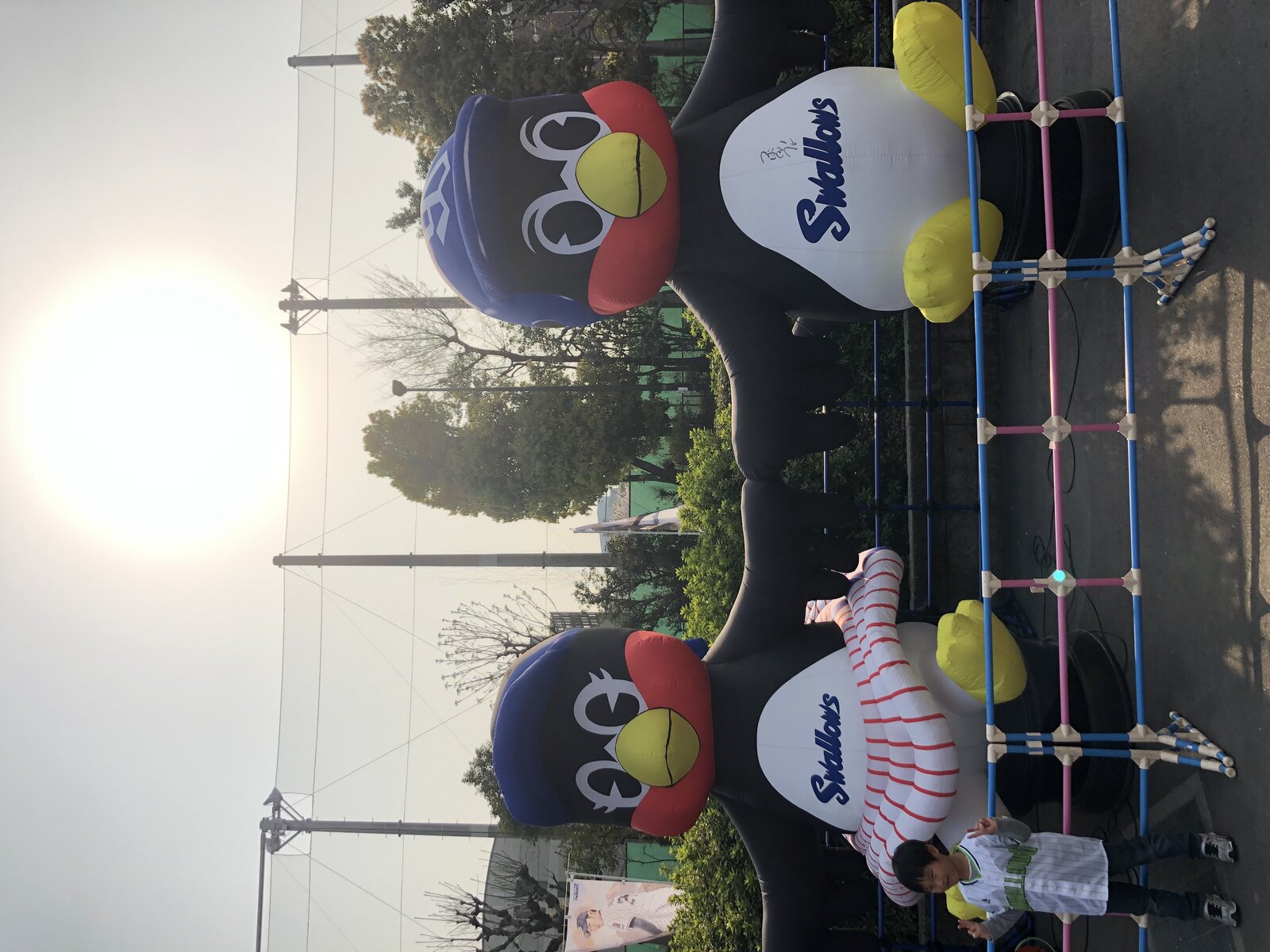 I did not get a picture with the mascots, unfortunately.
I used to think I had to make sure I plotted the course of my life string, knowing which twists and turns I needed to take in my life. In reality, life tangles your string, knots it and turns it into an inscrutable map. Good luck trying to simultaneously make sense of, and untangle your past while plotting your future. Meeting that father-son duo and converging our life strings for a couple hours reinforced my growing belief that the best experiences are completely unexpected and will have an immediate, lasting impact on your life. The best advice I’m giving myself in baseball, in my career, and in my life is to trust myself. Stop giving myself arbitrary deadlines, enjoy the present, and everything will sort itself out. You’ll get to the bottom of the 9th inning soon enough, so enjoy the 4th inning while you can.